
Assessment is the process of measuring a person’s knowledge or skills. It’s not a science; it doesn’t prove anything, but passing a test or completing a practical task implies a certain level of competency. A special type of assessment (called formative assessment) is used to aid the learning process (this is called ‘assessment for learning’).
Bobby Elliot, 2003.
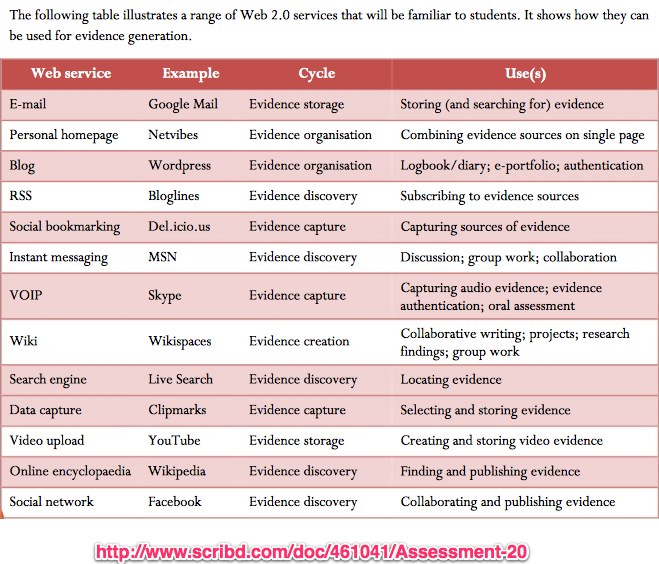
This table has changed my life! Well, may be not quite, but it has changed my perspective on assessment. My environment is higher education, private higher education. This has its own issues when assessing student’s work. I teach on a Masters in People an d Organisational development at a business school in the United Kingdom. Sometimes, students come from client organisations, sometimes they can become clients after the course, and sometimes they come to work for us as consultants. Transparency in assessment is important here, as is layers of peer review and checking standards of assessment across the faculty. How do we know that standards are comparable across the faculty? We implement a riguourous assessment process that is defined each time we start working with a new cohort – self managed learning works within a framework that Elley (1993) defines as collaborative assessment. Her focus is on how power is used in the process – ‘power together’ as compared to ‘power over’ the student or the educational establishment:
This model of power assumes that student, peers and staff work together to secure a common view of assessment and its outcomes, based on hearing and understanding different perspectives, and seeking to secure agreement which values all perspectives. This model is essentially collaborative, dependent on reaching consensus.
There are delightful and tangled issues that arise from this assessment model, not least the point of friction between traditional university assessment methods and how we assess students at my business school. Until today I had always seen collaborative assessment as a cross I had to bear for working at a non-traditional university. Now I see that I have been working at the leading edge of assessment for many years and have never stopped to critically reflect on the heutagogy that is implied in self managed learning as an approach to education.
What Elliot (2008) crystallised for me in his table above is that in traditional education we shoe horn evidence for learning into a shape fixed by the educational establishment in order for it to award its accreditations. This is contrasted with what in the literature is defined as ‘assessment for learning’:
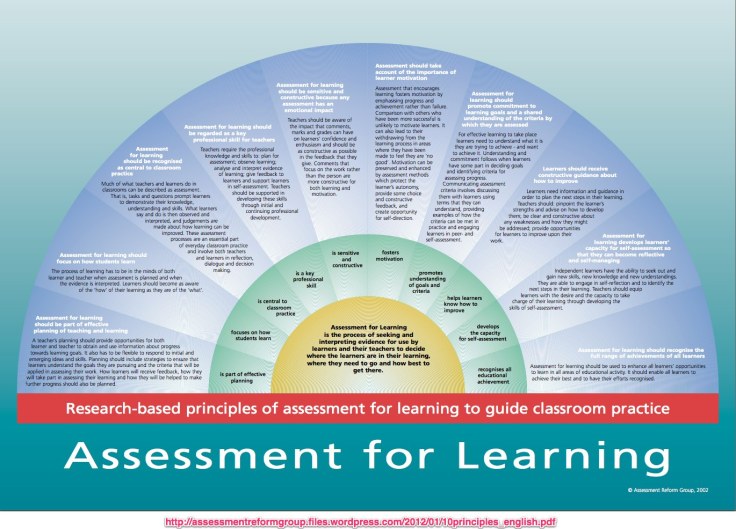
“the process of seeking and interpreting evidence for use by learners and their teachers to decide where the learners are in their learning, where they need to go and how best to get there” (ARG, 2002).
This definition obscures the core question: who determines what counts as evidence of arriving ‘there’? In my world of work this is a collaborative process revisited afresh at the start of each cohort. Most of the literature I have read on this focusses on schools and how assessment needs to be redefined to support pupils on learning rather than exercise power over them by assessment of learning. This is not my area of work, so I will say no more than that I understand that there is a lot of prescriptive work that needs to be done to help teachers and educational government departments understand this distinction. Self managed learning is being used in schools by some pioneers but I know little about how successful these initiatives have been. I count myself lucky that my focus on assessment is in dealing with the downsides of being at the other extreme of the assessment for learning continuum: When I started to read about assessment for learning from my ivory tower, I just asked: Is there any other kind?
I want to focus the rest of this post on the content of Elliot’s table above. A key insight is summed up by Al-Rousi (2013) and focuses on the type of evidence that supports learning:
Elliott [is] focused on the use of digital evidence [… ] naturally occurring, [ i.e.] already existing […] not created solely for assessment purposes, [manifested] through multimedia, [and] distributed across different sources.
Elliot is indeed saying that instead of shoehorning evidence we might choose to purposefully build in the use of naturally occurring evidence into our assessment process. He is further saying that we need to use web 2.0 tools to develop an e-assessment strategy and this he calls Assessment 2.0. Self Managed learning works with naturally occurring evidence, but has no e-assesment strategy embedded in its approach. Collaborative assessment in self managed learning ensures that the evidence to be sought is outlined in the learning contract upfront and this can be any type of evidence that supports the learning outcomes being defined. We encourage students to use wide sources of evidence such as video files, audio files, essays, reports, flowcharts, lesson plans, storytelling, painting, spreadsheets and self-assessment statements.
What we are not doing enough of is looking at the use of digital evidence to support learning in an embedded way. If we define e-assessment as anything that involves digital media, then we have been doing it for years – word document are submitted, we add our formative feedback via Track Changes, use spreadsheets to tabulate data, create research reports, etc. This is not what Elliot intends to suggest when he talks about assessment 2.0 in my view. He quotes Downes (2006) notion of a personal learning environment and posits the need for a Personal Assessment Environment (PAE) where students use the type of web 2.0 tools exemplified in his table to critically reflect on what it means to provide evidence for learning, set it up before getting on with the business of learning, harvesting it for insights regularly and then ordering it in a meaningful way to demonstrate achievement of a given standard which in my domain is Masters standards. This notion is game changing for me. It implies that digital literacy would no longer be a choice for our faculty or our students, that an e-assessment strategy has to be agreed and implemented to further support students that goes beyond just allowing students to present their evidence as e-portfolios (which by the way we still do not allow for administrative reasons: students have to print to copies of their portfolio on paper and hand in by a specific date…).
Whilst Self managed learning meets most of Elliot’s characteristics when assessing for learning in terms of its principles of operation (e.g. being collaborative, peer and self assessed) it falls down when assessed against his ‘tool supported’ characteristic. Some may argue that what matters most is that the principles are adhered when developing effective assessment strategies in any educational domain, that tools used are a secondary consideration. I disagree with this assertion. Our thinking is shaped by the tools we use. Writing a blog is not the same as writing a letter or and essay. Assessment for learning in a self managed learning Masters means supporting students in the creation of a PAE to gather tangible evidence through their 18 months learning journey. Our challenge in this is almost as hard as that of other educational sectors when shifting from one preposition to another. We already assess students for learning, but how might we design assessment 2.0 into our work?
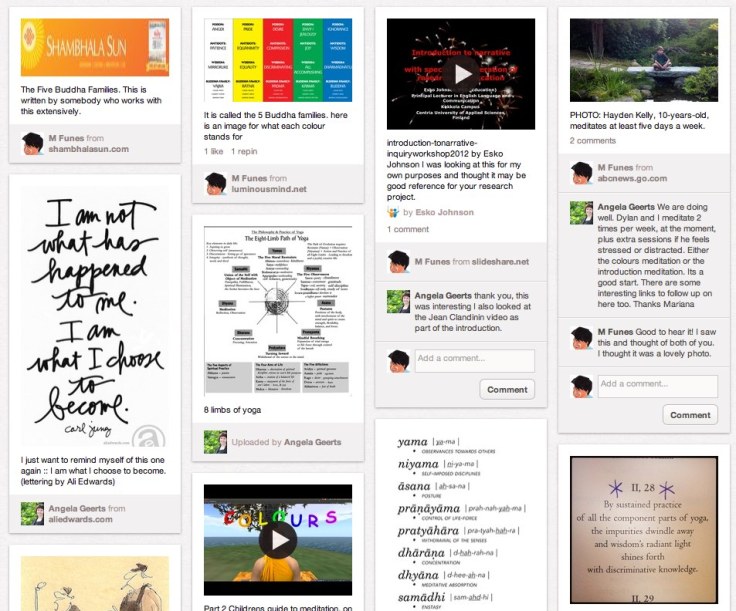
A modest experiment I am carrying out is the use of Pin-Interest to support evidence gathering and dialogue for one of my student’s learning contract. The board’s theme only makes sense in relation to the student’s learning contract, we agreed to keep comments general enough for the board to be public but specific enough that the student could track her learning journey when it came to writing up. We also agreed that the board would be part of the evidence used to support her self assessment statement on achievement of learning goals for the Masters. However, whilst we are using it for formative feedback, I fear that, at best, screenshots of the board will be all that makes it to the final portfolio.
My understanding of what Elliot proposes with Assessment 2.0 is that we need to incorporate the distributed nature of digital evidence (amongst other characteristics he discusses) into the way we assess students rather than students having to shape their evidence into a fixed format limited by low digital literacy in certain sectors of the educational establishment. In embedding these tools into the formative stages of learning we would be enhancing the quality of their thinking and preparing them to develop a digital identity that can support them in their future career goals – given the ever increasing need to learn to function effectively online for most professionals.
Al-Rousi, S. (2013) ‘Does WEb 2.0 = Assessment 2.0’ http://learn.open.ac.uk/mod/oublog/view.php?user=1124720
Assessment Reform Group (2002) Assessment for Learning: 10 Principles http://assessmentreformgroup.files.wordpress.com/2012/01/10principles_english.pdf
Eley, Ginney. “Reviewing Self-Managed Learning Assessment.” , 1993. http://www.heacademy.ac.uk/assets/documents/resources/heca/heca_lm09.pdf.
Elliot, Bobby. “Assessment 2.0.” , Sept. 2008. http://www.scribd.com/doc/461041/Assessment-20.





 doublemirror
